The Secret to Making Your Emails Less Used Car Salesman and More Truffle
 Before I was a full-time copywriter, I used to live in the awesomely charming mountain town of Bozeman, Montana. And sometimes, on my walks home from work, I used to stop at the chocolate shop and buy one piece of exquisite handmade chocolate.
Ah, the “Nipple of Venus.” I remember it well!
Dark chocolate ganache inside with a kiss of amaretto, topped with a dip of white chocolate.
Sure, it was 2 bucks. But oh, how I savored it!
And this, my dears, is how I want you to approach every email you send.
Not like a 36-pack of Hershey Bars from Costco. But like a little, playful dark chocolate secret.
Here are some ways to get your emails and articles into Truffle Mode:
1) Give away your best ideas. Share freely. Tell your list what you are learning. Reveal a recent A-HA moment. Show your surefire solution to a problem that keeps coming up as you talk with clients and colleagues.
2) Let them see you having fun. This is something I learned when I was in grad school for teaching. One of my professors insisted that no one would listen – or learn – if I was all business, and no sass. Same goes for you: be playful, silly, outrageous. Let your light shine!
3) Plug into your mission. Yes, yes, you want to make a living. But really, why are you doing the work you do? Connect with that fire, and you WILL be writing from an inspired, attractive place.
4) Forget “business as usual”. So many emails and newsletter are so yawn-riffic because they are a chore, and not a transmission of your joy, love, and expertise. As Gandhi has famously said, “Be the change you wish to see in the world.” What message do you long to hear in your life? If you whispered the perfect thing to one of your favorite clients that would make a huge difference in their biz, what would it be? That, my dear, is your “Nipple of Venus.”
This post is the fourth in a 6-part series on using the web to fill your programs and practice and sell out of your products. Coming up next: Why is a copywriter talking about my back-end?
Get Your Website Selling Like IHOP on Sunday
 Get the right ingredients
in your website mix
The Troubleshooter’s Guide to Websites that Sell Like Hotcakes
Your website gets compliments all the time. Your friends and clients keep telling you they like it. It’s a pretty website. Maybe you even paid a fair chunk of change to a designer and a copywriter to get the website you’ve got.
And still, it’s not really bringing you business.
What gives?
When you’ve got a pretty website that’s not bringing your business, here are the usual suspects:
1) You don’t have a sales page. Selling online isn’t just adding a “buy now” button and waiting for results. You know all the calls, lunches, free workshops and speaking you do offline to get your face in front of people who want to work with you? There are online strategies for doing the same thing—and a sales page for your program, event, or product is one. (No, Really. What’s a sales page?)
2) You aren’t clear on your “pathway.” Most people aren’t going to fork over their credit card on a $500 program first. They need to know, like, and trust you. Do you give away a free sample of your work, like a script, MP3, or white paper that helps them right away – without having to buy anything? On your website, is it clear which problem you help people solve? Do you offer a free first session and a chance to hear more from you over time?
3) You care about helping people, not “selling” them. Deep breath here. Many healers, coaches, and service professionals are concerned about being “too salesy”. If this is you, let me reassure you that sending emails and setting up your website so that it sells for you doesn’t have to be soulless, selfish, or tacky. So let that belief go… and chew on the fact that you can also reach and help more people if you set your website up in a more active – and interactive way. (So get out of your own way!)
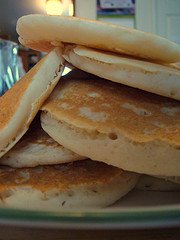
This post is the third in a 6-part series on using the web to fill your programs and practice and sell out of your products. Coming up next: The Secret to Making Your Emails Less Used Car Salesman and More Mocha Truffle. Oh, and thanks to rcstanley's flickr photostream for the pancakes.
Righto. What’s *In* a Sales Page, Then?
Find Out What You Need On Your Sales Page
Give Your Sales and Program Numbers a 10%, 20% Even 30% Boost -- Without Spinning Your Wheels
“As long as it takes to make close the deal.”
That’s how long your sales page needs to be. I’m in the middle of writing copy for a program that launches at the end of January, and when my clients got their first draft of the sales page, they nearly fell over.
“It’s so long!”
As long as it takes. And the tests bear this out – when it comes to selling, longer copy works better. But only if you’re covering all your bases. That is, what your ideal clients need to know before they feel great about signing up for a program or buying something from you.
Here’s a little trick I use to get my head around what those “bases” are. I’m big on reusing stuff, so I cut my stack of 8 ½ x 11 scratch paper into quarters – but you can use 3x5 cards.
And empty your brain about your program, info, product, event, or service, taking one card (or more) for each item below. Forget full sentences – bullets are great.
1) What’s the problem?
2) Why hasn’t the problem been solved yet?
3) Your solution & why it works
4) A 5-sense description of the outcome of your solution
5) What people will get, learn or discover when they use your solution (ideas, knowledge, outcomes)
6) What’s included in the cost (“things”, products, time with you)?
7) What people should do now? (Your “call to action”)
Your guarantee – how do you take the risk out of trying it out?
Yes, Virginia, there is a lot more to it than that. But this is the first step to creating solid copy that moves people towards signing up with – or buying from – you. And that can dramatically improve the number of people who do what you’re inviting them to do.
This post is the second in a 6-part series on using the web to fill your programs and practice and sell out of your products. Coming up next: Why Your Website Isn't Selling Now... and How to Fix It